Saturday, 13 October 2012

Synapse science news #2


Too busy to keep track of all the science news during the week? Don’t fear Synapse is here. Check out this week's news.

Curious rock discovered on Mars - The Mars Curiosity rover has been hard at work. This week it discovered a rock with an exceptional composition, never before discovered on the planet. Read more here.

Billions needed to save nature - The world is currently going through a biodiversity crisis. At this week’s Convention on Biological Diversity scientists concluded that $76 billion dollars a year is required to reduce the risk of extinction for threatened species, by establishing protected areas. Tough choices face policy makers. Is it worth it? What do you think? Find out more.

Failure to launch! - On Tuesday (9/10/2012) Austrian adventurer Felix Baumgartner prepared to go supersonic and travel faster than sound by skydiving from a helium balloon. Unfortunately, after entering his capsule and getting fully prepared the dive was cancelled due to high winds. A second attempt was planned for Thursday, but this was also called off. The balloon carrying Baumgartner plans to travel to 120,000ft (36.5km), making it the highest skydive ever. A third attempt is likely to take place on Sunday (14/10/12). Keep up to date with the latest news on the mission here and read more about the mission here. 

Nobel Prize winner was written off at school - John Gurdon always wanted to be a scientist but his school master said this was ‘quite ridiculous’ and a 'sheer waste of time'. This week, the now ‘Sir’ John Gurdon, was awarded the Nobel Prize in physiology/medicine for his work proving that adult cells can be reprogramed and grown into different tissues in the body. I guess teachers are not always correct! Read more here.


The diamond planet - A new rocky planet has been discovered. Scientists believe it is similar to Earth, but with one major difference; this planet’s outer crust is largely composed of solid carbon crystals, meaning much of its surface is coated in diamonds! The diamond planet is orbiting a distant star named 55 Cancri, around 40 light years away from Earth. Read more here.

David Blaine does Tesla proud - OK it’s not really science, but this week American illusionist David Blaine spent 72 hours channeling one million volts of electricity while wearing a 20-pound chain-mail suit. Check it out.

The most unpleasant sounds - Scientists have identified the most unpleasant sounds for the human auditory system. Can you guess any? Well here are a few from the top 10: chalk on a blackboard, fork on a glass and a female scream. Check the full list here. When we hear sounds such as these there are increased interactions between the brain region that processes sound, the auditory cortex, and the amygdala, that relates negative emotions.

Eco-Friendly Optics - Spider silk is an extraordinary natural material. Now it is believed it could be used to catch and manipulate light, making it an eco-friendly alternative to more traditional ways of manipulating light, such as through glass or plastic fiber optic cables. Read more.


Tom Stubbs and Felicity Russell

Friday, 12 October 2012

The Art of Science 2012

Louisa Cockbill

The Art of Science is a creative arts competition run every year by the Faculty of Medical and Veterinary Sciences at Bristol University; it is open to all researchers within the Faculty, including students. Can you capture the beauty within science? If so it’s not too late to enter, so give it a go, click here for more information. There are a bunch of great prizes and entries are displayed at @Bristol cafĂ© and have the opportunity to be selected for the Wellcome trust bio-images collection, check out their page hereCompetition entries are also placed in the popular Art of Science calendar. Entries from this year’s competition will be exhibited on Wednesday 21st November 9am - 6pm in D3 Medical Sciences Building.

Check out these great entries from previous years:

Harry Jepson, Alan Leard & Mark Jepson - 'Antenna Base'
Richard Hulse - 'Skinny fibres'
Emma Vincent - 'The Platelet Factory'
Chrissy Hammond - 'Jaws'
Louise Hickey - 'The Great Wave of Neurone'

Find out more about the competition, click here  

Saturday, 6 October 2012

Synapse science news #1


Too busy to keep track of all the science news during the week? Don’t fear Synapse is here. Every weekend we will present a round-up of the week’s science news. Here is your first installment.

Buzz over multi-coloured honey - Beekeepers in northeastern France were amazed and concerned when their honey was turning blue and green. It turns out the bees were not feeding on their usual nectar. Rather than using natural plants they were feeding at a nearby waste factory for Mars, the confectionery giant. The blue and green colouration originates from the waste product of m&m's! Find out more, click here

Scientist at the University in Edinburgh plan to rip a hole in space and time! - They have received funding to run experiments that create an analogue to a black hole. Find out more, click here

Test tube spiders - The UK’s largest spider, the great raft spider, is having its three remaining populations enhanced using spiders produced in test tubes! Many of these critters have been raised at Bristol Zoo. Find out more, click here

Scientists name new species after Yoda - A deep-sea acorn worm, discovered 1.5 miles beneath the Atlantic, has been named Yoda purpurata. The large lips on the creature’s head are reminiscent of the Jedi master's floppy ears, apparently! Find out more, click here


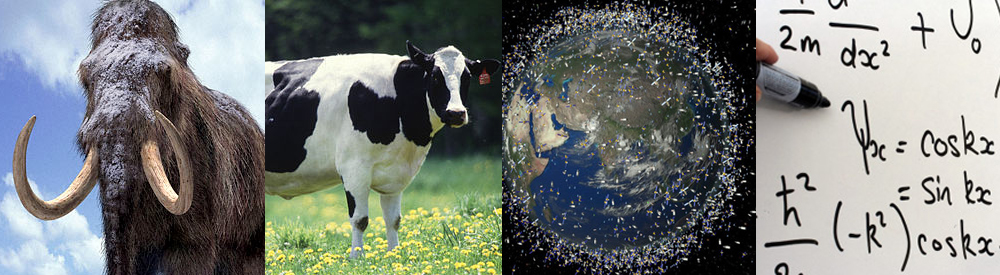
11-year-old Russian boy discovers almost complete woolly mammoth carcass - The 30,000-year-old remains of this 500-kilogram beast were discovered in the tundra of the Taymyr peninsula in northern Russia. Doubtless the debate about the possibility of cloning a mammoth will be revived following this discovery. Find out more, click here 

GM cow designed to make allergy proof milk - A genetically modified cow that produces milk lacking a protein that causes allergic reactions in people has been created by New Zealand scientists. The cow was created with the same cloning procedure as Dolly the sheep in 1996. Find out more, click here

The dangers of space debris - Scientists fear the vast amounts of space debris surrounding Earth may cause massive problems in the future. Find out more, click here

Schrödinger's cat, dead or alive? - Physicists have been able to probe a delicate quantum state without destroying it. This goes against the enduring icon of quantum mechanics and suggests it is possible to take a peek at Schrodinger's metaphorical cat without killing it. Find out more, click here


Felicity Russell and Tom Stubbs

Wednesday, 19 September 2012

Weird and Wonderful: The Technicolor tree

Tom Stubbs


Believe it or not, this isn't the work of an artist. This is the Rainbow Eucalyptus tree (Eucalyptus deglupta), famous for its exceptional colour making it look like something from Narnia. The tree is truly a living dynamic piece of natural art, but how does it get this bizarre appearance? Unlike most trees we are familiar with that have thick ‘corky’ bark, the Rainbow Eucalyptus has smooth and thin bark. It frequently exfoliates these thin layers. As the newly exposed bark ages slowly it changes colour, beginning with bright green and darker green, then bluish to purplish, then pink and orange, before it finally reaches a brownish maroon and falls off. These individual slices of bark are constantly changing at different rates meaning the tree is always changing colour and there is always a great range of colours. For obvious reasons the Rainbow Eucalyptus is a very popular ornamental plant, although it originates from the rainforests of Mindanao (Philippines). While we are on the topic of colour, check out this amazing little moth, the Rosy Maple Moth (Dryocampa rubicunda) from North America, how cute.


Saturday, 8 September 2012

Reach for the stars


NASA astronaut and flight engineer Sunita Williams appears to touch the Sun in this amazing photograph snapped from space. It was taken during the 32nd expedition to the International Space Station after an epic 6 hour spacewalk on September 5th 2012. The astronauts had been making routine repairs and installing a Main Bus Switching Unit (MBSU). Earlier this week two astronauts at the international space station were forced to make repairs with a $3 toothbrush, they saved around $100 billion of damage. The Space Station is currently home to six astronauts: Sunita Williams and Joe Acaba of NASA, Aki Hoshide of the Japan Aerospace Exploration Agency, and Russian cosmonauts Gennady Padalka, Yuri Malenchenko and Sergei Revin.

Monday, 27 August 2012

Weird and Wonderful: Death’s Head Hawk Moth

Gemma Hallam

Death’s Head Hawk Moth
No it’s not from Star Wars or Dr Who, but it did hold a starring role in The Silence of the Lambs! It’s the largest moth to be found in Britain, measuring up to 13cm fully grown. The Death’s Head Hawk Moth comes from Tropical Africa, but spends time during late-Summer migrating to tepid areas of Europe, Northern Ireland as well as southern and eastern England.

These poor fellows have become an omen of death as they have a skull-like marking on their ‘chest’ between their head and abdomen.  The 3 species of Death’s Head Hawk Moths all have sinister names; Atropos – a member of the moiari who cuts the thread of life in Greek mythology, Lachesis – another of the 3 moirai, responsible for deciding the length of a person’s life thread, and Styx – the river to the underworld. The third moirai, Clotho, may have missed out on the allocation of one of the species, because her role in the trio is deciding when people are born and she can bring people back from the dead; far too optimistic for association with these gloomy moths!

The caterpillar comes in 3 coloured varieties: a light green/yellow with darker stripes (as pictured), a pale blue shade with washed-out stripes, and a brown snakeskin type with a white head, which makes it look like a bird poo! They do not hatch from their larva with the stripes, but develop them at the 3rd out of 5 stages (or instar) of being a larva (before they become a caterpillar). They’re not very active and only move to feed (sound familiar?), but they are feisty! If disturbed, they thrash about in an attempt to gnash their attacker with their mandibles.

The insects have relatively short proboscis (protruding tubular noses used for feeding) rendering it incapable of reaching into plants to feed on the nectar. Instead, they feed on honey, tricking the bees into not attacking them by squeaking in a way similar to the Queen Bee. If a guard bee attacks them, it’s not too much of a problem because with their immunity to the bee sting and thick, protective bodies, they can handle a bit of hassle, however, after drinking honey, the moths can’t squeak for about 5 hours and have to make a swift exit from the hive. They’re aided in doing so through ‘chemical camouflage’, emitting an odour containing the 4 fatty acids that bees carry around. This has earned the species the nickname ‘bee robbers’, but they will settle for rotting fruit and tree sap. The larva feed on potato leaves (although this has decreased with the rise of mechanical farming), buddleia and ominously, deadly night shade.

Death’s Head Hawk Moth caterpillar - James Twose
Although there’s all this negativity related to the Death’s Head Hawk Moth, you can’t help but admit they’re striking fellows. They have dramatic black and yellow stripy hindwings (they have 2 pairs of wings) and abdomens. Their pupae are a lovely deep mahogany and shiny, although thinking on it, they may also look a bit like a poo. My sympathy is with them!

Check out this video about the Death’s Head Hawk Moth:

Saturday, 18 August 2012

Weird and Wonderful: Glaucus atlanticus, the real life Pokémon

Tom Stubbs


This peculiar creature has only recently become famous and many people have still not even heard of it. The most amazing feature of this animal is its stunning appearance, looking like a cross between a dragon and a PokĂ©mon! In fact Glaucus atlanticus is a sea slug, in the group Gastropoda, that also includes snails and land slugs. G.atlanticus is actually rather small reaching a maximum size of around 3cm. Despite its small size this miniature dragon mimic has many amazing characteristics. They use gas bubbles in their stomachs to float in the water column and pursue prey using appendages to swim. Amazingly G.atlanticus feeds on hydrozoans, including the infamous deadly Portuguese Man O’ War. They have the ability to harness poison from the stings of prey and use this as a defensive sting themselves, which unlike most sea slugs, can hurt humans. Finally, G.atlanticus is also a hermaphrodite possessing the reproductive organs of both sexes!

Spread the word about this amazing little critter and check out the video below:

Sunday, 12 August 2012

Evolution of the athlete

Felicity Russell


As the London 2012 Olympics draw to a close and we have watched how our athletes push their bodies to the extreme to achieve award winning performances, it is easy to see what an amazing species we are. A species more advanced compared to the many other living creatures that we share our planet with. Especially as our closest living relative happens to be the chimpanzee, that split from us 6-8 million years ago. How is it that tree dwelling apes evolved into a species capable of such athleticism? Only recently numerous fragmentary fossils have been discovered which start to reveal our origins and how we came to evolve.

Sahelanthropus
The oldest suspected hominin species found is Sahelanthropus, thought to be 6-7 million years old. The skull appears ape-like but has a distinctive browridge like other identified hominin species. The hole at the base of the skull where the spinal cord passes (foramen magnum) is horizontally orientated suggesting a bipedal posture. Another indication of a hominin species is provided by the shape of its teeth, Sahelanthropus has small canines unlike the larger sharp ape-like canines. Ardipithecus ramidus and Ardipithecus kadabba, thought to have lived between 5.8-4.3 million years ago, are two more examples of hominins where tooth shape indicates a more human like function. However, clues found from Ardipithecus toe bones controversially suggests bipedalism, as joint surfaces are different in humans whose feet flex up to a greater extent than chimpanzees.

Australopithecus species, such as Australopithecus afarensisAustralopithecus anamensis and Australopithecus africanus, lived approximately 3 million years ago. They have thicker tooth enamel compared to apes and the shape of their canines and premolars suggest a more human function. The presence of shorter, broader hips is indicative of a more human like posture and leg bones have revealed human like features. The Paranthropus group, often thought as part of the Australopithecus group, existed 2.5 million years ago. They are also described as bipedal and interesting dental evidence suggests they were especially well adapted to eating nuts and seeds.


Early Homos, such as Homo habilisHomo rudolfensis and Homo erectus are thought to have lived within the last 2.5 million years, coincident with discoveries of stone tools. A bigger brain size has often been associated with early Homos, suggesting they are more like Homo sapiens (‘intelligent man’). Three new fossils have recently been discovered supporting claims that Homo rudolfensis is a separate species from Homo habilis. Later Homos include Homo heidelbergensis, Homo neanderthalensis and Homo floresiensisHomo heidelbergensis lived 300,000 to 700,000 years ago and wooden spears have been found nearby indicating that they hunted large animals. Homo neanderthalensis are thought to have used more advanced stone tools to carve meat from larger mammals. They had a large browridge and a human-sized brain. They are also known to have buried their dead and the more recent Neanderthals also made simple jewellery from animal teeth. They may have gone extinct as recent as 30,000 years ago. Homo floresiensis is the most recent distinct species, living up to just 17,000 years ago. They were short, often referred to as hobbits, and despite having smaller brains researchers have still found evidence that this species also used tools. Homo sapiens may have existed as long as 200,000 years ago originating from Africa and by 30,000 years ago they replaced Neanderthals in Europe.

Did humans evolve to run? ILLUSTRATION BY PHIL DISLEY
Noakes and Spedding (2012) have now suggested that it is our ability to run and to dissipate heat which aided our evolution. As forests disappeared and large open savannahs appeared, our ancestors had to adapt and evolve from a skeleton developed for tree climbing to a structure required for walking and even running. A lack of body hair and the ability to sweat as much as 3 litres in an hour meant we could lose heat more easily and enabled us to chase after four legged prey which require panting as a mechanism to dissipate heat. The prey would not be able to pant and run at the same time and eventually would be driven to heat stroke. The development of longer legs, shorter toes, a stronger gluteus maximus, larger weight bearing joints and broader shoulders is suggested to have aided our ability to run long distances. We have also been able to develop an aerobic capacity capable of supporting such long distance runs unlike any other ape species. Therefore as you celebrate how extraordinarily well our athletes have done for London 2012, remember how remarkable evolution can really be.

Fun point: Australopithecus anamensisAustralopithecus afarensisAustralopithecus africanus – try saying this over and over again it is definitely a tongue twister. 

The evolution of human stance


More information:

Fossil record of early humans - http://www.becominghuman.org/node/human-lineage-through-time

Wednesday, 8 August 2012

The Animal Olympics

Tom Stubbs

We are over halfway through the Summer Olympic Games of 2012. Over the last week we have witnessed some incredible feats of speed and strength and multiple world records have been broken. But how do us hairless bipeds compare to other members of the animal kingdom?

Speed kings
Usain Bolt won the 100m sprint gold medal with a time of 9.63 seconds and in the 2008 Beijing Games he ran 9.69 seconds to win gold. More impressively, in the 2009 World Championships Bolt set two world records, running 100m in 9.58 seconds and 200m in a time of 19.19 seconds. This consistency has established him as the fastest human athlete ever. However, compared to some members of the animal kingdom Bolt looks like a bit of a slouch. The cheetah could complete the 100m sprint in 5.8 seconds and it is around twice as fast as the world's top sprinters, reaching speeds of 64mph. Bolt’s 200m record would be smashed by a cheetah that would complete it in just 6.9 seconds. The pronghorn antelope is another speedy competitor with running speeds of around 55 mph. If the pronghorn entered the 800m it could complete it in an incredible 33 seconds. To put this into context, the Kenyan 800m world record holder, runner David Rushida, ran that distance in 1 minute, 41 seconds.

Stamina, strength and swimming
How do our athletes compare in other Olympic events? Well this year’s Olympic gold long jump was won by Greg Rutherford with a leap of 8.31m. The world record long jump is a whopping 8.95 meters, currently held by Mike Powell. This distance approaches the leap of the red kangaroo (12.8 m) but falls short of the snow leopard that can jump up to 15 metres. Behdad Salimikordasiabi is considered the strongest man in the world after winning gold in the men's +105kg weightlifting category, lifting 247kg in the final. An elephant can lift 300kg with its trunk alone and the Gorilla, one of our closest relatives, can lift an unbelievable 900kg! It would be hard to argue that Michael Phelps is not the greatest swimmer of all time. In a 200m freestyle race Phelps swims around 4mph, a sailfish can travel at speeds of 67mph!


Although these comparisons may seem rather strange because the various animals mentioned are adapted to a specific mode of life, it does serve to highlight the incredible athletics abilities evolved through natural selection. Equally, these comparisons highlight the exceptional versatility of the human body. With training, athletes are able to tune their bodies to specific tasks. Can you image finding individuals within any other species that have such variation in speed and strength? This is what the Olympics places in the spotlight.


Check out the videos below!

Bolt vs. Cheetah 


The 10 Fastest Creatures on Earth

Wednesday, 1 August 2012

Ants, Bees and Brains

Alicja Jedrzejewska

Ants, bees and brains, or more specifically rock ants, honeybees and neurones, have surprisingly a lot in common. However insignificant when singled out, when grouped together as a swarm, colony or a brain, they can generate astonishing properties. Are the properties of these superorganisms enough to conclude they can think as one, just like the brain? In other words, is there colony-level cognition?

An example of such an emergent property is colony-level decision making exhibited by ants during house hunting. The scout ants visit potential house sites. They collect information about the site, including the size of the cavity, the width of the entrance and the darkness.  If a scout ant evaluates the house to be appropriate, it starts teaching other ants the way to the new house, so they can also evaluate it. This is done by secretion of chemicals called pheromones along the path to the house. The other ants can smell these chemicals, which allow them to trace the correct way. This behaviour is known as tandem running, and enables other ants to visit the site and decide for themselves whether they think it is a good site or not. If a nest is of good quality, a scout will wait less time before recruiting others to it, whereas if it is of poor quality they will wait a lot longer. This period of waiting is the latency period.

House hunting ants
When enough ants are present in the new nest a quorum is reached, and the whole colony makes a decision to move. This is a rapid move whereby ants start carrying other ants on their backs to speed up the process. The quorum threshold depends on individual situations. In times of danger speed is more important than accuracy so the quorum threshold decreases drastically (less ants have to be present in the nest in order for a decision to be reached), whereas when the colony is safe the quorum threshold rises so a more accurate decision can be made.

Just like ants, bees reach the decision of moving their hive collectively. Individual bees go out looking for new hives. When they encounter an appropriate site they do a waggle dance in front of the other bees. The waggle dance informs the other bees about the location of the site. This allows the other bees to investigate the site by themselves. The better the site the longer the bees will dance for. With time more and more bees start to dance advocating their ‘favourite site’. When there is a close match between two sites bees start to ‘buzz’ one another in an attempt to silence the bees advocating the competing site. This allows for a collective, final decision to be made.

Just like ants and bees, neurons ‘make’ decisions collectively. An example of this can be seen when a person is presented with a screen with some dots going right and some left and a decision has to be made as to where most dots are going. Some neurones will be firing due to left dot movement and others due to right movement. Final decision is based upon the larger number of neurones firing for either side.

So there you go! Ants, bees and brains have more in common than you originally might have thought. A lot of research in this area is still going on and we are learning more and more about the fascinating properties of colony-level cognition. Some of the pioneering research in this field is actually being carried out by researches at the University of Bristol. If you would like to know more about the information in this article let us know via email or otherwise, and we will provide you with the references used to write it.

More information:

Waggle Dance of the Honeybee - http://www.youtube.com/watch?v=bFDGPgXtK-U


Sunday, 22 July 2012

The science behind Spiderman

Tom Stubbs

Superheroes have amazed audiences for almost 80 years. They showcase a spectacular range of supernatural abilities; but are any of these possible? The video below examines the abilities of Spiderman. Could a retrovirus cause immediate cell mutation? Can spider-size physics be scaled to a human? Is there such a thing as 'spider-sense'? Find the answers in the video below and share with your friends.


Video from ASAP Science - http://www.youtube.com/user/AsapSCIENCE