
Showing posts with label News. Show all posts
Showing posts with label News. Show all posts
Friday, 12 December 2014
Thursday, 10 April 2014
Sunday, 3 November 2013
Synapse Science News #1 #Nov2013

Too busy to keep track of all the science news during the week? Don’t fear Synapse is here. Check out this week's news.
Doomed Planet gives hope for other Earths – Kepler-78b is the first exoplanet discovered which shares both a similar mass and composition to earth. Unfortunately, it is far too close to its star making it burning hot and inhospitable. However, despite its position, it’s similarity to Earth gives new hope to astronomers that other earth like twins are waiting to be found. Read more here.
Cheating Light defies Newton’s 3rd Law – A team of researchers found that laser pulses may accelerate themselves around optical fibre loops seemingly defying that every action must have an equal and opposite reaction. Such behaviour may only be applicable in light but provides a possible source for improving electronics and communications in the future. Find out more here.
Final phase of dark matter hunt imminent – Particle detector LUX has been shown to be the most powerful detector of its kind but it failed to detect any dark matter during its first run. In 2014 its second run is set to probe deeper once again which, if our theories about dark matter are correct, should ensure that dark matter is indeed detected. Read more here.

Rachel Greenwood

Sunday, 21 July 2013
Have you got a science breakthrough you could present in 3 minutes? This is your chance!
 |
|
Photo
Credits: Falling Walls Lab winner 2012, Thomas Rippel, copyright Falling Walls
Lab
|
A.T. Kearney London invites students, scientists, and innovators to share their research and entrepreneurial ideas at the Falling Walls Lab in London on 20th September 2013.
The Concept
The Falling Walls Lab offers young
academics, professionals, and entrepreneurs a high profile platform to showcase
their innovative research to a panel of luminaries from the worlds of academia,
research, and business.
The winners of the London Lab will be offered the chance to take part in the final Falling Walls Lab in Berlin, where they will share their innovative ideas with 100 finalists from around the globe. Winners also receive a complimentary entrance to The Falling Walls Conference, the International Conference on Future Breakthroughs in Science and Society.
The winners of the London Lab will be offered the chance to take part in the final Falling Walls Lab in Berlin, where they will share their innovative ideas with 100 finalists from around the globe. Winners also receive a complimentary entrance to The Falling Walls Conference, the International Conference on Future Breakthroughs in Science and Society.
Last year’s keynote speakers included
Chancellor Angela Merkel and other prestigious members.
The catch? You only have three minutes to pitch your idea to the panel - "Dragon’s Den"-style.
The catch? You only have three minutes to pitch your idea to the panel - "Dragon’s Den"-style.
Background
The Falling Walls Lab was launched in 2011,
a collaboration between The Falling Walls Foundation and A.T. Kearney, to give
young scientists and professionals a global platform for their innovative
ideas.
Following the successful kick-off in Berlin, the challenging, fast-paced format was expanded to a number of international cities in 2013.
Following the successful kick-off in Berlin, the challenging, fast-paced format was expanded to a number of international cities in 2013.
Who
Can Apply?
Master students or PhD candidates, young
professionals, scientists, or entrepreneurs from all disciplines, under the age
of 35, are invited to apply. The Lab is open for participants from all
countries. Willing participants will apply their idea and if successful,
present at the Falling Walls Lab in London.
Prize
Being part of the London Lab gives you a
high level networking platform, an opportunity to engage and exchange with key
decision-makers and like-minded innovators, and a chance to represent your
institution on a global stage.
The winners of the qualifying London Lab will be given the opportunity to present their research at the final Falling Walls Lab in Berlin where they will share their winning ideas with 100 finalists from all over the globe.
The prize includes a ticket for the Falling Walls Conference, the International Conference on Future Breakthroughs in Science and Society. Your travel and accommodation costs to Berlin from 8-9th November 2013 will be covered.
The winners of the qualifying London Lab will be given the opportunity to present their research at the final Falling Walls Lab in Berlin where they will share their winning ideas with 100 finalists from all over the globe.
The prize includes a ticket for the Falling Walls Conference, the International Conference on Future Breakthroughs in Science and Society. Your travel and accommodation costs to Berlin from 8-9th November 2013 will be covered.
When and where?
When
20 September 2013
Starts 1:30 p.m.
Where
The Westbury Hotel
Bond Street, Mayfair
London
Application Deadline
21 August 2013
Click here to apply
Monday, 17 June 2013
Friday, 26 April 2013
Synapse Issue 4
Synapse issue 4 is here! You can find print copies of the magazine all over The University of Bristol campus.
Saturday, 23 March 2013
Synapse science news #15

Too busy to keep track of all the science news during the week? Don’t fear Synapse is here. Check out this week's news.
The Fatter the Better: what it takes to be a polar bear - As sea ice is lost from their habitat polar bears are having to rely on their fats reserves because they can no longer hunt seals, based on 10 years of data from an article recently published in the Journal of Animal Ecology.
Our next icy target - After the rovers success on mars the next target is being eyed up: Jupiter's icy moon Europa. It is thought there could be an underground ocean with the potential for life. However landing could be lethal with Jagged blades of ice potentially covering the equatorial area of Europa. Read more here.
One Giant Happy Squid Family - These huge cephalopods that live in the deep ocean were thought to be from 8 different species, but results from DNA sequencing form 43 samples indicates they are all one species. Find out more.
What does your phone activity say about you? - Mine probably very little - but apparently it is the new way to catch gangs in Italy. New technology called LogAnalysis makes it easy to visual the activity, and helped show how there was a flurry of activity amongst gang members before a crime but crucially none during. More information.

New publication from UoB includes how plants tell
chloroplasts the time of day. Click here.
Crocodile Dundee would not be best pleased an alligator
received a prosthetic tail this week. Find out more.
Sunday, 17 February 2013
Synapse science news #14

Too busy to keep track of all the science news during the week? Don’t fear Synapse is here. Check out this week's news.
Earth’s close call – This week the small Near Earth asteroid, 2012 DA14, passed by Earth. Read more.
Deadly coronavirus in UK – Multiple people being treated in intensive care. More information.
Drilling on Mars – Curiosity rover takes historic drill sample, although it was only 6cm deep! Read more.
Sea slug has disposable penis - Japanese researchers observed this bizarre mating behaviour in a species called Chromodoris reticulate. Find out more.

Mosh-pit behaviour – Science behind collective behaviour is being investigated using mosh-pits. More information.
Downtime for the LHC – The large hadron collider is being turned off for a 2 year upgrade and maintenance period. Read more.
Drive you round the bend – Self driving car technology is being developed in the UK. More information.
Treatment on the ocean floor? – Researchers are beginning an £8m project to discover new antibiotics at the bottom of the ocean. Read more.

Katherine MacInnes and Saraansh Dave
Sunday, 10 February 2013
Synapse science news #13

Hi-tech specs - Hi-tech spectacles could help cure blindness - no more problems with telling green and red apart! This new invention, by an american research institute, could allow colour blind people to see the full spectrum of colour. Read more.
Alzheimer's figures might triple by 2050 - A new study based on increasing ageing population predicts that the number of people with Alzheimer's disease will triple. More information.
Elephants on the brink - 11,000 elephants have been killed in the last 8 years. In Gabon since 2004 thousands of elephants have been killed for their ivory in a situation called "out of control." Find out more.
Magnetic salmon - Sockeye salmon use a magnetic field to get home. A new study in Current Biology states they use the memory of the magnetic field when they first entered the sea to find their way home. Read more.

Mary Melville
Sunday, 27 January 2013
Synapse science news #12

Dung beetle's guide to the galaxy - Could dung beetles really be guided by the galaxy. More here.
Can Stress chemically silence genes which are passed on to offspring? - Scientists have recently found evidence to suggest this is true. Read here for more.
First world problems? - Will scientists solve the problem of chocolate melting on your biscuits? More information here.
"Fascinating" - The Star Trek Tracker Beam has been invented in miniature. Read more here.

Sunday, 16 December 2012
Synapse science news #11

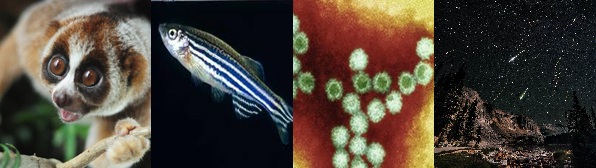
New primate discovered - Scientists have found a new species of slow Loris in Borneo. Read more.
Handy fish - Zebrafish are being used to study the evolution of limbs from fins. Scientists have been able to make them develop 'pre-hands' instead of fins by controlling their genes. Read more.
Norovirus in hospitals this winter - Wards closed to visitors due to vomiting bug. For more information.
Global meteor show - The annual Geminids meteor shower took place this week, peaking on Thursday 13th. Don't worry, it is not related to the end of the world! More information here.
Felicity Russell and Tom Stubbs
Sunday, 9 December 2012
Synapse science news #10

Too busy to keep track of all the science news during the week? Don’t fear Synapse is here. Check out this week's news.
Urban adaptation - Birds are taking and using cigarette butts to repel pests. Read more.
Earth at night - NASA releases night-time satellite images of Earth. Check out what city lights look like from space here. See them here.
Catch-up with Curiosity - Curiosity is yet to find complex organic
carbon-rich compounds essential for life. Check out the analysis of the Rover’s
soil sample and the future plans for its Mars adventure. Read more.
Super solar power - Ghana government uses Feed-in-tariffs to incentivise building of largest African solar energy plant. It plans to provide electricity to 100000 homes, wow! More information.

Earth timeline from the BBC - Check out these stunning images
illustrating the amazing events that changed our world through time here.
Invisibility cloaks coming soon? - Invisibility cloaks getting a step closer for all you
Harry Potter fans. Scientists have been
able to design a two-dimensional, unidirectional cloak. For more information, click here.
The life of a woolly rhino - A
preserved woolly rhinoceros body reveals insights into how, the once most
abundant mammal in Eurasia, lived. Read more.
Elephant concerns - Kenyan
elephant numbers drastically decline in last 4 years. Check out how the demand
for Ivory is threatening the existence on one of our planet’s most spectacular
animals. Read more.

Saraansh Dave
and Felicity Russell
Saturday, 1 December 2012
Synapse science news #9

Too busy to keep track of all the science news during the week? Don’t fear Synapse is here. Check out this week's news.
Men are from Mars and women are from Venus - New evidence suggests men and women view and interpret the world very differently. Evidence comes from a study conducted here at Bristol University. More information.
Long lasting bread - Wouldn't bread that can last 60 days be amazing. No more trips to Sainsbury’s just to make some toast! An American company says it has invented a way to make bread last 60 days by zapping it with microwaves to remove spores. Read more.
Holy moly! - The second largest black hole ever has been found. It resides in the galaxy NGC 1277, that is just a quarter the size of our own Milky Way. Find out more.
Snooze you win - More sleep is the way forward. Even 2 hours can be as effective as a painkiller. Read more.

Imaging the famous corkscrew - Scientists have been able to take a photograph of a double helix for the first time, using an electron microscope. More information.
Ice on the scorched world - What are the chances of finding ice on the planet closest to our sun? Very high according the NASA! Data from the Messenger spacecraft has recorded over 100 cubic kilometres of ice at the planet’s poles. Read more.
Overdosing on grapefruit - Research suggests that mixing grapefruit with prescription drugs can have very adverse effects. Find out more.
Pac-man on Saturn’s moon - Astronomers have identified variable heat signatures on Saturn’s moon Tethys that look like Pac-man! Read more.

Mary Melville and Katherine MacInnes
Sunday, 25 November 2012
Synapse science news #8

Too busy to keep track of all the science news during the week? Don’t fear Synapse is here. Check out this week's news.
Curiosity makes historic discovery - Nasa's Curiosity team says it is poised to make a 'historic' announcement in the near future. This is a massive teaser as very little information has been given and NASA are usually reserved when it comes to making major claims. Read more.
Dog’s nose reverses his paralysis - Scientists have helped a dog regain the use of its legs by injecting olfactory ensheathing cells taken from the lining of its noses into the its spine. This research may help those seeking a cure for paralysis. More information.
Support for science - Vince Cable has been standing in Science’s corner this week. He plans to challenge plans for cuts in spending on engineering and science being considered by George Osborne. Read more.
The island that wasn't - An island in the South Pacific called ‘Sandy Island’ has been proven not to exist! Find out more.

Louisa Cockbill and Tom Stubbs
Subscribe to:
Posts (Atom)