Showing posts with label geology. Show all posts

Wednesday, 13 November 2013

Ten Extinct Animals you wouldn't want to meet in a dark alleyway

by Rob Cooper


1. Daedon: the ‘terminator pig’

Nicknamed the ‘terminator pig’ this hulking brute of an animal was a member of the ungulate family that today includes pigs, giraffes and deer. It had enormous bony flanges similar to the warts of the warthog which accompanied its titanic jaws giving this predator a bone crushing bite in addition to its fearsome tusks.


2. Titanoboa: the giant snake

This great serpent emerged just after the demise of the dinosaurs in the Paleocene epoch and was estimated at 15 meters long and a weight of 1135kg making it easily the largest snake that has ever existed which would not be vexed in the slightest by swallowing a comparatively measly human.


3. Deinosuchus: 'terror croc' 

One of the three largest crocodilians to have ever existed Deinosuchus could have reached lengths of twelve meters and lived alongside tyrannosaurs such as the fabled T.rex and is theorised to have predated upon the dinosaurs that unknowingly came to drink from cretaceous watering holes. Okay, maybe it wouldn't have fitted in a dark alleyway but such a creature does not deserve to be neglected. 


4. Argentavis: the largest flying bird


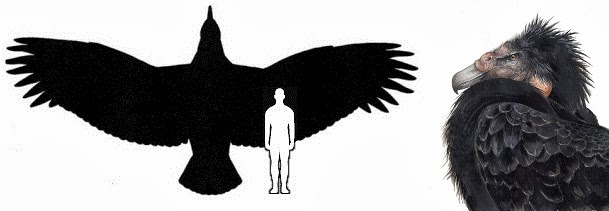
The largest flying bird to have ever lived had a wingspan of around seven metres and would have likely scavenged and displaced Miocene predators from their kills. It’s skull morphology suggests it was suited to swallowing prey whole so whilst humans may lie someway from its preferred prey it would still make for an intimidating site emerging from the darkness. 


5. Gigantopithecus: the real yeti 

The legend of the yeti has fascinated many people throughout history and there seems to have been no better candidate than Gigantopithecus. This ape stood at around three meters tall and while its teeth indicate it was exclusively vegetarian an unexpected encounter with such an enormously powerful ape would be far from desirable. 


6. Arctodus simus: the giant bear

Arctodus Simus, the giant short faced bear could look you in the eye whilst still remaining on all four legs. If the titan deigned to stand it would have easily reached three meters in height. Around 11,000 years ago Arctodus Simus is proposed to have filled the niche of a kleptoparasite; intimidating smaller predators such as dire wolves, Smilodon and American lions from their kills with its enormous size and strength.


7. Utahraptor: flesh eating dinosaur 

There had to be at least one theropod (clade to which all carnivorous dinosaurs belong) dinosaur in here. Considering T.rex or Giganotosaurus would find it near impossible to fit inside an alleyway we’ll take the lesser known Utahraptor. The Velociraptor in Jurassic park may have been greatly exaggerated in size, being in reality the size of a turkey, but Utahraptor dominated even these exaggerated raptors reaching seven meters in length and with a sickle claw nine inches in length clearly indicating this 126 million year old predator could disembowel a human with consummate ease. 


8. Megalania: giant monitor

The size of this giant monitor lizard is difficult to determine as several studies place the weight anywhere from 300kg to nearly 2 tonnes. Regardless Megalania is still a monster compared to any modern day lizards. With heavily built limbs and a huge skull full of viscously serrated teeth it is proposed to have hunted Australian megafauna such as Diprotodon the ‘giant wombat’. If that wasn’t bad enough it seems likely Megalania, akin to modern monitor lizards such as the komodo dragon, was venomous making Megalania not only the largest terrestrial lizard but the largest venomous vertebrate to have ever existed. 


9. Kelenken: terror bird 

Picture a three meter tall bird with a skull 28 inches long, 18 inches of which was composed of a beak that was used in the same manner as an axe to inflict debilitating injuries on its prey and you get a rough idea of why it might be a good idea to stay the hell away from Kelenken. Belonging to the aptly named ‘terror birds’ this particular animal had the largest head of any bird known and was theorized to have either delivered viscous hammer blows to crush the bones of large prey or grab hold of smaller prey and shake them in much the same way that a dog might shake a rat today with the small addition that Kelenken would usually end up breaking the back of the unfortunate organism.

10. Euchambersia: Permian predator

By far the smallest animal on this list Euchambersia was a reptile that lived before the dinosaurs in the Permian period 250 million years ago. Euchambersia was a member of the therapsid order of reptiles which included the ancestors of modern day mammals and are often referred to as the ‘mammal like reptiles’. Despite its small stature this predator had an ace up its sleeve… Venom. The large canine teeth clearly exhibited by Euchambersia had venom grooves connected to venom glands in a very similar way to modern snakes in order to inject venom into the prey upon biting down. This killing strategy made Euchambersia a force to be reckoned with in the Permian deserts of South Africa.

Do you have any other suggestions? Let us know in the comments section.

Wednesday, 16 October 2013

The Cyclops: A Huge Terrible Beast

by Rob Cooper


‘As tall and ragged as an alp’ and with a ‘voice like thunder’ in the loosely translated words of Homer from book nine of the Odyssey; the Cyclops was indeed a menacing spectre. As with all legends it seems wildly fanciful to imagine there was such a grumpy one eyed old giant that lived alone butchering sheep and bashing brains from hapless Greeks in his spare time. However, there is some evidence as to what might have inspired the creation of such a story and the progenitor is by no means a less terrifying or majestic apparition.

Around eight million years ago there really was a ‘huge, terrible beast’ wandering around Greece. Its name was Deinotherium giganteum and it literally means ‘huge terrible beast’. The animal in question was a relative of the modern day elephant and stood 4.6 meters tall at the shoulder and could have easily massed over 10 tonnes, making it one of the largest extinct Proboscids (the group containing modern elephants) to have walked the earth, only eclipsed by the titanic imperial and possibly the steppe mammoth. The skull clearly shows an enlarged gape where in life the trunk of the animal would have attached and curious recurved backwards facing tusks which actually emerged from the lower jaw in contrast to the forwards facing tusks emerging from the upper jaw of modern elephants.


Deinotherium also had an enlarged nasal opening situated further back in the skull which indicates a particularly well developed trunk although the specifics of its appearance are difficult to gauge. The prominent trunk, along with the backwards facing tusks, imply Deinotherium may have been adept at manipulating tree branches or other objects in order to reach food. Other proposed uses of the peculiar tusks include the stripping of bark from trees as well as digging for roots and tubers. The 1895 compendium ‘Curiosities Of Science’ even stated: 

‘The family of herbivorous Cetaceans [i.e. sirenians] are connected with the Pachydermata of the land by one of the most wonderful of all the extinct creatures with which geologists have made us acquainted. This is the Deinotherium, or Terrible Beast. … It appears to have lived in the water, where the immense weight of these formidable appendages [i.e. tusks] would not be so inconvenient as on land. What these tusks were used for is a mystery; but perhaps they acted as pickaxes in digging up trees and shrubs, or as harrows in raking the bottom of the water.’

Noting the close relationships between the early whales and elephants and concluding that Deinotherium was too monumentally huge to have lived anywhere other than an aquatic environment and may have used its tusks in order to obtain food from the bottom of lakes and rivers.

Unfortunately the fossil evidence of Deinotherium is still inconclusive as the recovered teeth are suitable for both grinding and shearing indicating a varied diet and there are yet to be found any tusks with clearly preserved marks or scratched to indicate any particular use. 

So how does this tie in to the Cyclops? Many archaic cultures discovered fossil evidence of truly giant animals and it makes sense that the farming oriented Greeks might happen along a skull or two of the extinct Proboscid that used to inhabit their land. How would they have interpreted the skull of such an enormous creature? Perhaps the hole in the front of the skull was interpreted as an eye socket and the genesis of the Cyclops thus occurred. Thomas Strasser, archaeologist at California state university, Sacramento claims ‘With no concept of evolution, it makes sense that they would reconstruct them (fossil bones) in their minds as giants, monsters, sphinxes, and so on,’. 

This line of thought is particularly appealing when considering just how many similarities creatures of the past and legend share. From comparing sea serpents and plesiosaurs to dragons and dinosaurs and even sauropod leg bones to giants it seems likely that our ancestors best attempts at interpreting the fossils may have been manifest in the legends they created; and while they may have been some way of the reality, they were still thrilling to imagine. 

Deinotherium was recreated in walking with beasts interacting with early hominids - check it out in this video!

Thursday, 10 October 2013

Who says you need air and sunlight to live?


Scientists find life thriving in the hostile oceanic layers of the Earth’s crust


by Daisy Dunne

Scientists studying the activity of the “dark biosphere”, the portion of the Earth shrouded in both darkness and mystery, have revealed how tiny organisms called microbes can obtain the energy required for life directly from their rocky surroundings of the oceanic crust - the layer of rock found covering the Earth directly beneath the sea. Life found deep within the oceanic crust of the Earth has the potential to make up the biggest ecosystem, a functioning unit considering all living organisms as well as their physical environment, the world has ever seen. This is due to the fact that 60% of the Earth’s surface is covered by oceanic crust. This new discovery poses a great challenge to pre-existing views concerning the normal conditions of life, which are based on the theory that energy is fixed by plants from sunlight and passed from organism to organism through a food chain. In contrast, scientists have shown how an astounding number of organisms can exploit energy from the natural reaction of infiltrating sea water with the inorganic (non-living) substances found in the rocky crust.

Why is this new revelation so important? Finding a thriving community of organisms living independently of sunlight and oxygen strengthens the idea that there may indeed be life on other planets. Similar life forms to such microorganisms could potentially exist be deriving energy in the absence of appropriate light from rocky deposits found in their own planet’s constitution. One of the microbiologists behind the paper, Dr Mark Lever, hopes his findings will contribute to our understanding of extra-terrestrial life. He suggests, "I think it's quite likely there is similar life on other planets. On Mars, even though we don't have oxygen, we have rocks there that are iron-rich. It's feasible that similar reactions could be occurring on other planets and perhaps in the deep subsurface of these planets." This research opens a whole new door to the possibilities of life in hostile but mineral-rich environments, both on Earth and on other planets, that were previously disregarded as unsuitable to sustaining life.    


Monday, 20 May 2013

Diamond Origins


As you pass a jewellery store in town you may notice the large number of diamonds displayed in the shop window ready to grab the attention of the numerous loved up couples. Recently in Geneva a colourless, pear-shaped, 101 carat diamond sold for a world record auction price of $26.7 million. This is just over £17million. So what makes diamonds so special? Diamonds consist of a lattice of carbon atoms and it requires large amounts of pressure and extremely high temperatures to transform carbon into diamond. This high pressure and heat can be found in the Earth’s mantle where diamonds are formed. So how do we manage to get our hands on them? Well, diamonds are brought to the surface of Earth by powerful magma eruptions. These are found by mining in the form of rough crystallised stones and then need to be cut to make jewels. Rough diamonds are cleaved, sawed, cut and polished to form the diamonds we see in shop windows. The price is determined by the cut, clarity, weight (carat) and colour. Clever marketing is then what helps make these gems so desirable. So what is so special about diamonds? Well it is a tiny bit of sparkle formed under the surface of the Earth which undergoes a long journey to get under the surface of our hearts.


Diamonds found on the Earth's surface will have come from the mantle or outer space!

Tuesday, 13 November 2012

Curious activity and interplanetary jet lag

Hannah Bruce Macdonald

Curiosity, NASA’s Mars rover, has become the first instrument to carry out X-ray diffraction on another planet. Curiosity has paused on its journey to ‘Rocknest’ to perform its first test on the soils, while simultaneously removing any contaminants from Earth which it might have taken with it on its journey to space.

This comes after the team’s relief of shifting to normal working days for their study of Mars, after spending the first 90 days of the mission following a Martian time frame with 24 hour 39 minute days. Now those working on the project have recovered from interplanetary jet lag, they have set Curiosity to start shifting the sand to isolate the particles smaller than 150 micrometres and analyzing it.


The results of x-ray diffraction have shown significant amounts of feldspar, olivine and pyroxene. The sands themselves have been formed from sandstorms, meteorite collisions, or by the chemical breakdown of rocks through the action of water or oxygen. This soil sample is comparable to basaltic soil found in Hawaii, a volcanic island. These deposits have come from the Gale crater, which the scientists predict was an area that has passed from a wet environment to a dry one. The minerals are consistent with this, indicating limited interaction with water.

This research is all carried out with the notion that Mars could have supported microbial life, which makes the comparison to sands found on Earth and the suggestion of water interaction such an exciting one.

Monday, 5 November 2012

Methane Hydrates: A hidden source of global warming?


Hannah Bruce Macdonald

While it may seem there are already enough sources of greenhouse gases, a study has shown that large sources of methane may be released from their storage at the bottom of the sea. Off the East coast of North America large deposits of methane hydrate, a solid form of frozen methane trapped in ocean sediments, have been found. This methane hydrate is formed at the top few hundred metres of the ocean floor where the pressure is high and the temperature is low, far enough away from the Earth’s warm interior.

Changes in temperature and shifts in position of the Gulf Stream over recent years have allowed these methane reserves to ‘melt’ releasing 2.5 billion tonnes of methane. This gas is unlikely to move through the ocean to the surface, but will probably remain dissolved in the seawater where it will be converted by microbes. If this methane were to be released into the atmosphere, it would be unlikely to have much effect on global temperatures, but the main concern is for deep-ocean landslides. The breakdown of these methane hydrate reserves are capable of causing landslides in the seabed, which in turn have the knock-on effect of releasing even more methane, which could impact on global warming, while also having the potential to cause tsunamis.


Studies have been carried out using indirect measurements of sea-floor temperatures, from which the break-down of the methane hydrates has been inferred. On top of this little is known about the extent of methane hydrate present, or about the rate or mechanism at which this gas is released. Due to this, research is limited on methane hydrates potential as an energy source, or the effect it could have on global warming.